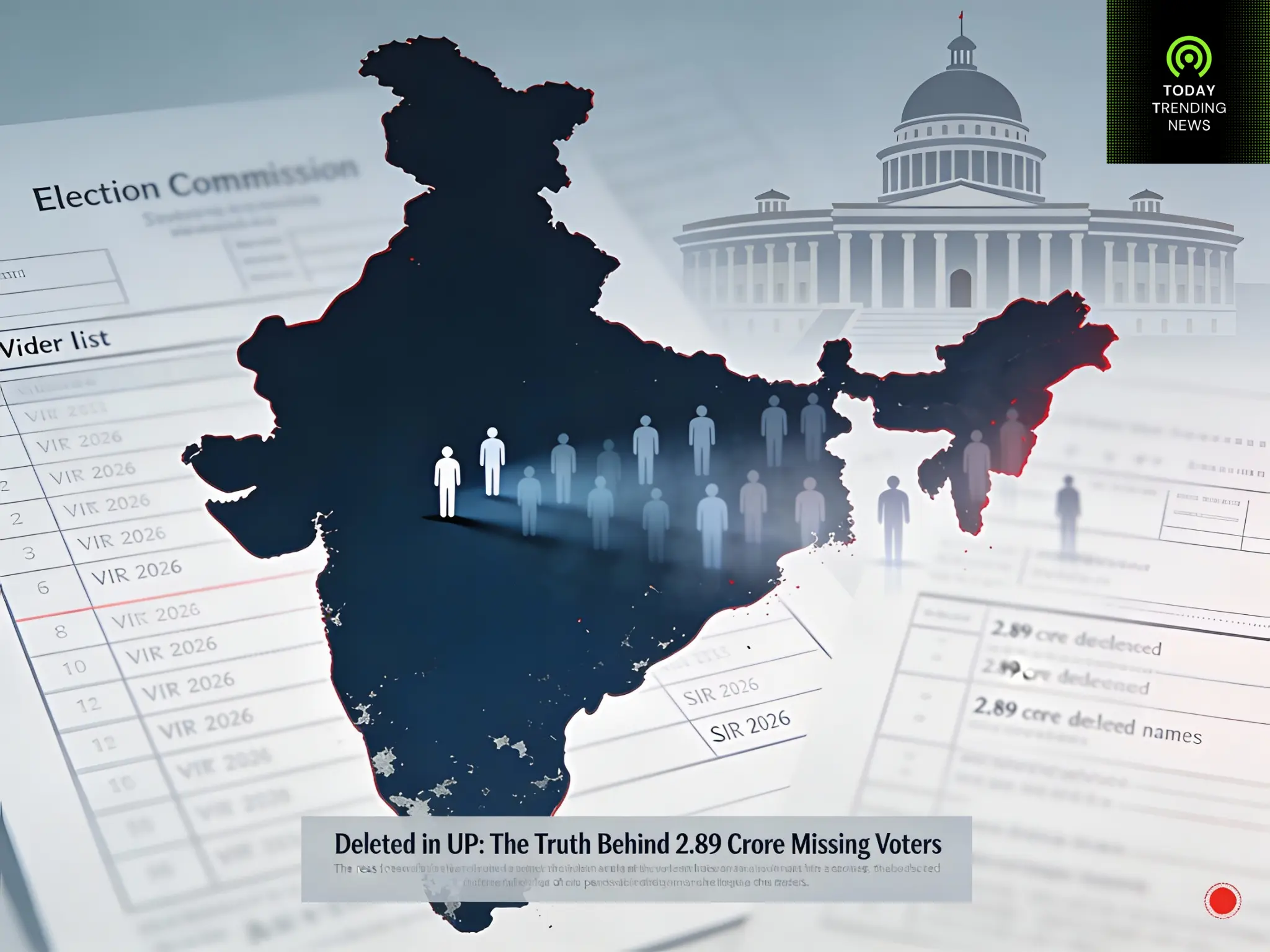
The reduction of about 2.89 crore names on the draft voter list will reduce the rolls of approximately 15.44 crores of the population, as to 12.55 crores voters in Uttar Pradesh in a Special Intensive Revision (SIR) of the draft voter list of 2026. It has created a political row with the Election Commission inciting it as a needed clean-up process and the opposition threatening with mass disenfranchisement.
What Is SIR And Why Was It Ordered?
Special Intensive Revision (SIR) It is a single intensive check of electoral rolls done under order of Election Commission when annual normal veiling would not be sufficient to correct past inaccuracies. In Uttar Pradesh, SIR will start by verifying door-to-door with Booth Level Officers in late October of 2025 and through use of individual forms of each of the 15.44 crore voters in the state.
The Commission has fixed 1 January 2026 as the qualifying date, and a draft roll to be published in early January which will be succeeded by a one-month time limit within which to claim and object as well as the ultimate publication of the final roll on 6 March 2026. This implies that the document is in form of a draft, and this is not the artificial list that will be employed in polling.
How Did 2.89 Crore Names Go Missing?
As per official records, there are approximately 12.55 crore voters on the draft roll, as compared to the previous 15.44 crore, having been deleted out meaning, some 2.89 crore names have been deleted, or have been deleted as 18.7% of the electorate. An overlay of a break up by the UP Chief Electoral Officer indicates that there were four large categories in the background of such deletions.
- At approximately 2.17 crore voters, there are shifted or that the parties were not found at the address in the physical verification.
- Approximately, 46.23 lakh names are of reported dead voters.
- There were almost 25.47 lakh multiple registrations (such as one individual became registered in more than one constituency).
- Another category of unmapped legacy entries of earlier roll needs further record keeping to be connected properly.
According to the state CEO, approximately 81 percent of voters submitted signed verification forms and that the non-response percentage is comparable to deletions particularly in major cities such as Lucknow, Ghaziabad and Prayagraj where the highest percentage of cuts occurs.
Also read: #SaveAravalli: Supreme Court Redefines Ancient Hills, Igniting National Fury
Politics And Fears of Disenfranchisement
The deletion of almost a quarter of the electorate in a state of great political importance casts doubt on fairness especially to the opposition parties such as the Samajwadi Party and Congress. They claim that SIR has been enforced in a manner that has a higher impact on the existence on some castes, minorities and opposition-heavy places and have required a special investigation into the procedure.
According to civil society and rights organizations, the poor, migrant, Dalit, and minority voters come to notice that their names have vanished only after they notice near elections, and it is literally unfeasible to make it on the rolls in time. Reports by commentators in national media like the wire and Hindustan Times note that the tight timelines and huge deletions can have the effect of disenfranchising people unless remedial measures are made easy and familiar.
The governing BJP has justified the exercise by its legality and as based on data cleaning up to eliminate dead and duplicate entries to ensure no bogus voting when all actual electorates still have redresses by the claims and objections process.
What The Election Commission And Official Data Say
The Election Commission asserts that it is conducting SIR in UP on the basis of Representation of the People Act and usual procedure of conducting elections. It also stresses that:
- What is given below is a draft electoral roll, which may be corrected and objections may be made against it.
- They have offered a month period during which citizens are allowed to submit inclusion, deletion or correction requests before the final list is frozen.
- The enumeration included Booth Level Officers and recognised political parties booth agents to introduce an additional cross-checking.
The headline figures of 2.89 crore deletions, 18.70 per cent of previous voters eliminated and ultimate publication of the roll set for early March after amendments was confirmed by independent reporting by NDTV, Financial Expression and other national media, in general.
How Can Voters Check And Fix Their Status?
To individual voters, it is not only that many names have been deleted but the question is whether my name is on the list, and whether not. Explainers of national dailies give an explicit practice relying on formal platforms of the Election Commission.
Main options include:
- Making a visit to the Voters Services Portal of the Election Commission located under the options of Uttar Pradesh and downloading the corresponding PDF provided under the local booth.
- Going to the Chief Electoral Officer, Uttar Pradesh website for assembling as well as district-wise draft rolls and notices of the SIR.
- Through the National Voters Services Portal or the official voter Helpline App as per this installed step-by-step guide by the Indian express.
If a name is missing or incorrect, voters can:
- File Form 6: of submitting a fresh application or re-Application as an eligible voter.
- Use Form 7 against the wrongful deletions or inclusions.
- Use Form 8 to correct spelling, address or other details.
Such forms may be filed online on Election Commission portals or offline through Booth Level Officers and Electoral Registration Officers and the Election Commission has stated that such applications will be accepted and sent during the objection period.
Why This Story Matters For Democracy
Google itself provides directions on quality news content: the guidelines suggest the importance of transparency, linking it to the source, and finding original value: clear details of dates and authors, a responsibility statement displayed, and citation of outlying data. The UP SIR story exists at the junction of the three, namely, democratic rights, mass administrative action, and political contestation, so proper and professionally sourced reporting is particularly significant.
Provided that the SIR process actually eliminates only the dead, moved or duplicate entries and restores all the true voters who submit their applications in time, it can improve electoral integrity in the largest state in India. However, until awareness is high, it is hard to make corrections, or certain groups are disproportionately impacted, the removal of 2.89 crore names may be a study on how technical roll manipulations can change democratic engagement on such a large scale.



One thought on “Deleted in UP: The Truth Behind 2.89 Crore Missing Voters”