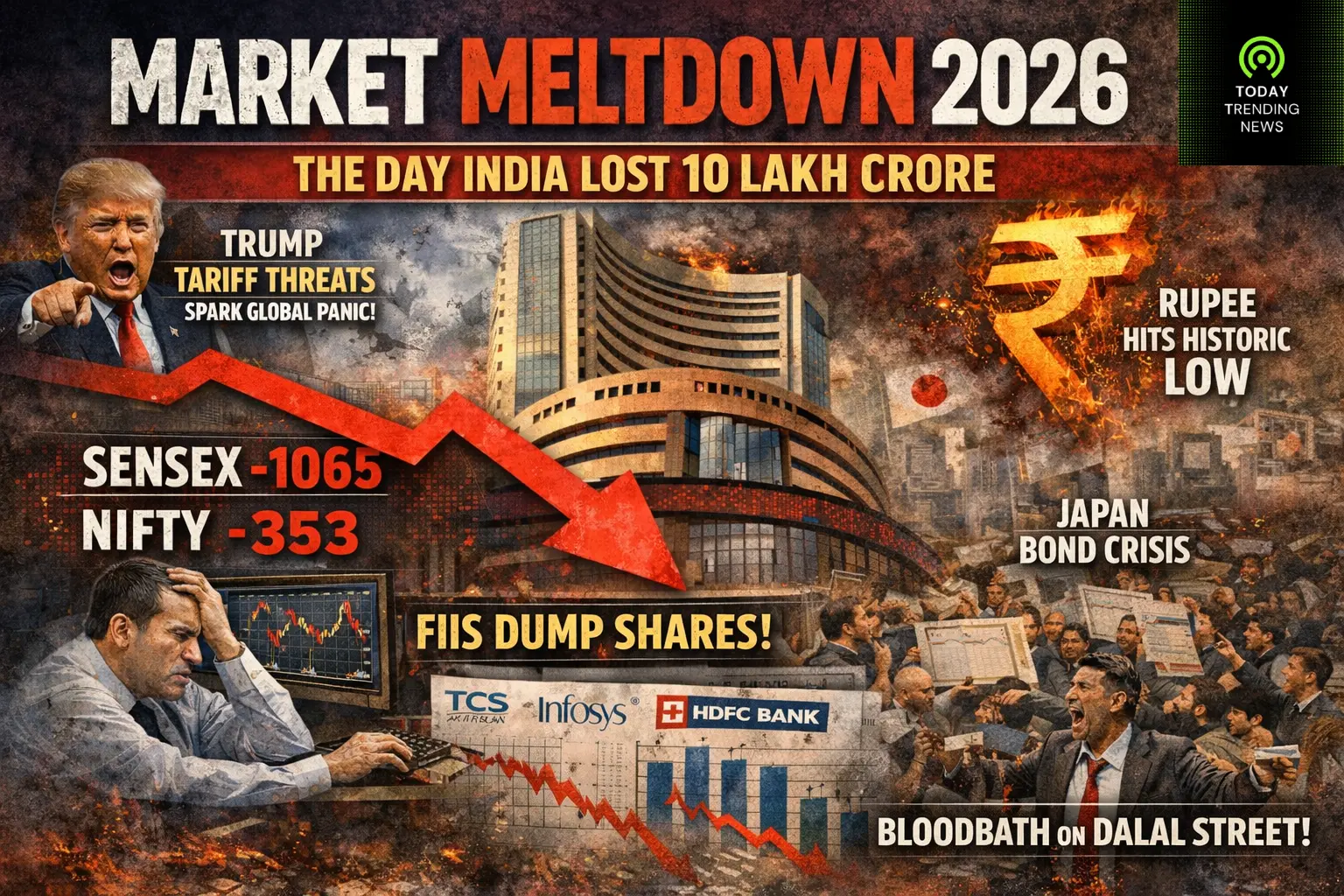
January 20, 2026 was one of the worst trading days in the recent history of the Indian stock market with the Sensex crashing by 1,065 points to close at 82,180 and the Nifty crashing by 353 points to close at 25,232. This carnival liquidation wiped off a market capitalization of more than 10 lakh crore of a company in a few hours, and investors were shell shocked and wondering how this blood bath had erupted.
Trump issues Tariff Threats causing World Panic
The main trigger of the crash of the market was the one-sided tariff announcements by US President Donald Trump on European countries, Canada as well as other international trade allies. Trump threatened to levy high tariffs, which may extend to 500 percent, on those countries who have trade relations with Russia, such as India. Such unprecedented threats of a trade war triggered risk aversion at a broad level across the global market with the investors running to the less risky assets.
The international balance counteractions rose to a new level after Trump even submitted threats to European countries that stand against US actions to annex Greenland, which led to another wave of selling equity all over the world. This outside force was a storm of confusion to emerge markets such as India especially.
Indian Equities Dumped by Foreign Investors
Foreign Institutional Investors (FIIs) have been on a selling spurt, selling Indian equities worth 29315.22 crore in the year January 2026 alone. This continuous capital flow, which is the result of the global risk-off sentiment and a stronger US dollar, has been one of the main reasons to increase the negative trend in the market. Conversely, Domestic Institutional Investors (DIIs) accumulated shares valued at 38,311.01 crore in the same year, which was not enough to offset the foreign outflow.
The ongoing FII sales indicates the apprehension of more rapid than anticipated Federal Reserve rate growth in the US, US Treasury yield increase and outflight of capital outflow by emerging markets. Such a steady outflow has caused a decrease in liquidity in the market and made all adverse catalysts heavier on the investor sentiment.
Also read: #SaveAravalli: Supreme Court Redefines Ancient Hills, Igniting National Fury
The Japanese Bond market Crisis Rocked the Global liquidity
Another purpose that was frequently ignored was the crisis in the bond market in Japan where the high bond yields were shaking the world liquidity. The upward US Treasury yields had ripple effects on the emerging markets where international investors had to review their hold on risky assets such as Indian equities. This tightening climate in the financial world was an extra burden to the already troubled market spirit.
Earnings at companies fall short in industries
Earnings season in the third-quarter turned out to be dismal to any confidence of the market as the major sectors posted dull and unimpressive performances. Key IT companies, such as TCS, Infosys and Wipro, reported poor quarterly performance due to a turnaround in technology expenditure in the world market and reluctance to make client decisions. The banking powerhouses such as HDFC Bank and ICICI Bank too failed to impress investors as the deposit figures pulled the banking index down.
Those disappointments on earnings did not confine themselves to individual segments, as a muffled quarterly result amid the large index constituents caused wholesale selling, and poor outlooks and margin stress degenerated the mood in the other sectors. Such a deviation in performance between the market valuations and the actual corporate performance created red flags of extended valuations.
Also read: Deleted in UP: The Truth Behind 2.89 Crore Missing Voters
Rupee Hits Historic Low
The rupee in India fell below the logic of 91-to-dollar, the lowest point in the history of the currency and contributing to the investor panic. The currency was spurred by various initiations such as the greenland controversy, the outflows of the foreign capital and lack of full-scale India-US trade agreement. A depreciated rupee will heighten inflation fears and make Indian equities less appealing to foreign investors, and this forms a vicious cycle of selling pressure.
Large-Scale Sectoral Carnage
The selling was extensive across all the sectoral indices showing a structural level of investor panic and not isolated feebleness. The Nifty Realty index also ranked as one of the worst index with a fall of 4.49 per cent within one session. Other sectors to be hit were Metals, PSU Banks, Oil and gas and IT that all fell between 1.5% and above 3%.
The wider market was hurt even worse as the Nifty Midcap 100 and Smallcap indices crashed down, proving that the adverse mood was far wider than the old blue-chip stocks. India VIX a measure of the volatility of the market shot high, indicative of increased nervousness on the part of traders.
The Acceleration of the Fall in Technical Breakdown
Technically, the fact that the Nifty 50 was breaking beneath key support bands at 25,500-25,600 was an indicator of further weakness to be anticipated. The support areas were broken at the beginning of the trading session, and algorithmic selling, stop-loss strikes and unwinding actions in short-term worked in the favor of the downwards momentum. Long bearish candles on daily charts together with the lossy momentum indicators implied that the market was in a sell-on-rise mode.
Technical analysts observed that the indicators continued to be in a bearish crossover and were about to hit oversold regions and the bears were firmly in control because bulls were becoming more marginalized. Unless the Nifty ignites the key ranges with a significant resistance, the experts predict that a bearish or sideways trend will most likely continue.
The Future of Investors
Five years to crash in January 2026 The January crash in 2026 will be the culmination of numerous headwinds: US tariff threats, worldwide tightening fears, incessant FII selling, poor results, currency devaluation, and technical failure. This has been a deadly mix, and it has ended a multi-week long bull run in a flash and pinned the markets at their lowest close point in three months.As much as a temporary reversal which may occur in the short run may be denied, long lasting recovery will be pegged on enhancement in these underlying factors. To the extent that there is no understanding regarding international trade matters, stabilization of funds flow, and evidence of profits recovery, Dalal Street may remain volatile. Market experts recommend that investors should be on watch with an emphasis on long-term fundamentals and they can assume the almost certain near-term turbulence with some maintaining that markets such as the financial sector, consumer discretionary sector as well as the industrial sector currently are a place where patient long-term investors can accumulate.