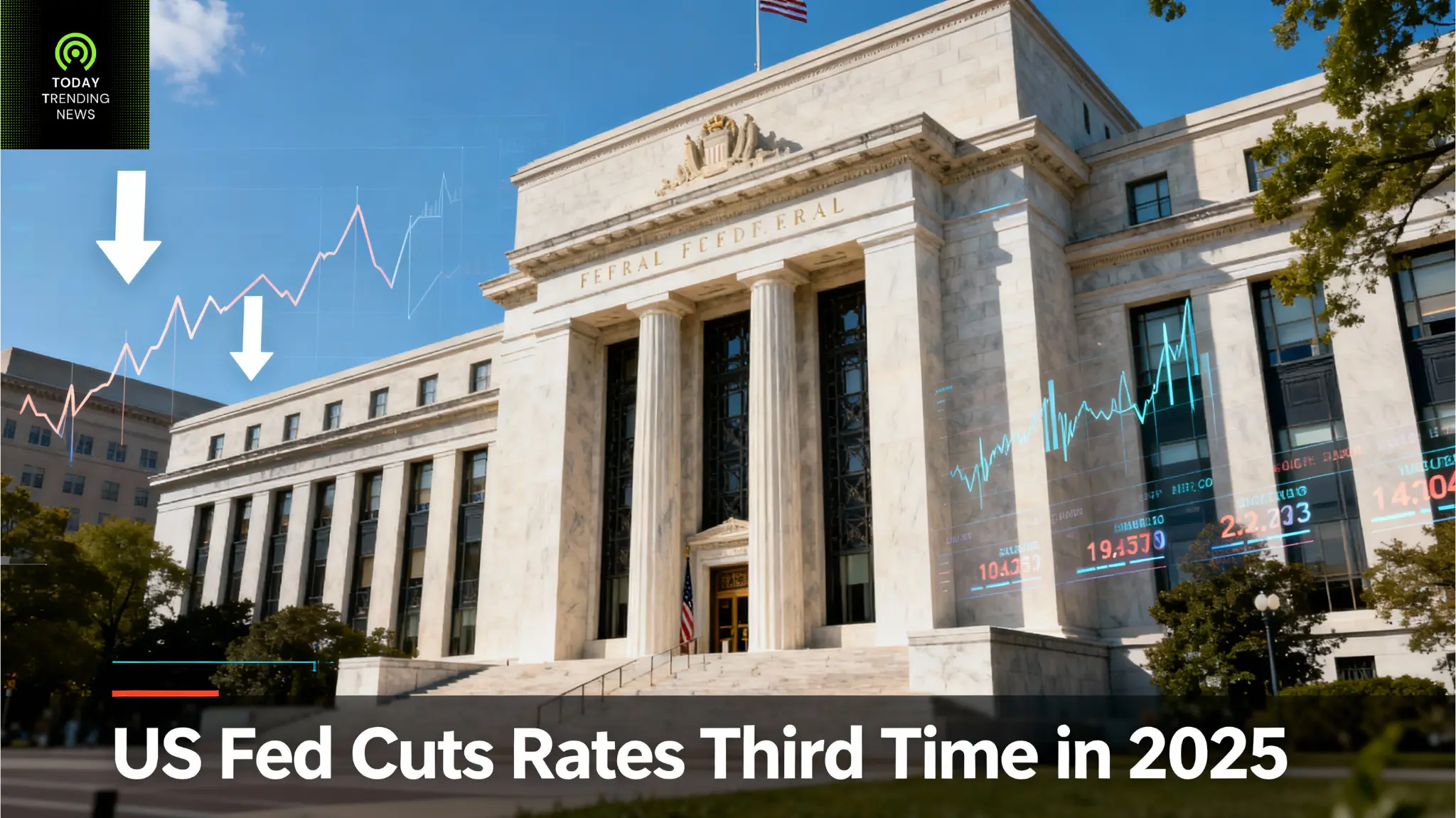
The interest rates in the US Federal Reserve were reduced the third time in 2025 and the Fed started to move towards the less aggressive tight-side policies and shifted to the more supportive direction as the rates of inflation diminished, and the growth rates reduced. This benchmark federal funds rate was reduced by 25 basis points by the central bank and the target range became about the mid-3 percent range, the lowest since 2022.
Why the Fed cut rates again
The Federal Open Market Committee (FOMC) voted 0.25 cut at its meeting in December following similar action in previous months of the year. The move was reached because official statistics indicated weaker employment improvements, decelerated wage increases and inflation approaching closer to 2 percent Fed target, which drew the policy makers further leeway to relax the policy without promptly causing a new inflation explosion.
Fed Chair Jerome Powell claimed that the committee continues to view risks of inflation but the monetary policy had previously been tight and now it should shift as the conditions shifted. Officials stressed that they are not on any pre-programmed road of cuts and are reviewing the rate at which it can be eased at each gathering depending on incoming economic figures.
Simultaneously, some policy makers were concerned with the speed of cutting, hence the committee was even more divided compared to the previous period in the year. This internal division highlights the perspective of not being sure of the future, despite the three consecutive rate cuts.
Impact on the customers and their daily Finance
The mortgage or card rates are not directly determined by the benchmark rate of the Fed but over a period of time it hugely affects the mortgage rates or card rates. When the policy rates start falling, the banks and lenders will also slowly revise the interest charged in taking out home loans, auto loans, individual loans and certain business credit, which usually leads to a sort of reduced EMI and interest rates on borrowers.
To families, this would bring some breathing room to monthly budgets particularly to those with variable-rate debts. Low borrowing rates also have an effect of promoting purchases that have big tickets like homes and cars that are significant in spurring the activity of the US economy. In the case of smaller, medium-sized firms, lower expense credit may also facilitate investing in equipment, technology and staffing in case demand supports it.
Market response to the third cut
The overall expectation of the December reduction in financial markets was high, yet investors paid close attention to the statements of Powell regarding the year 2026 and further. The move after the decision saw US stock indices rise as investors were optimistic that low rates would boost earnings especially in sectors dependent on interest such as housing, consumer finance and some of the technology sectors.
In bond markets prices of US government debt were lowered when traders started to assume that rates can remain at the same rate or even below even in the event that the Fed reduces the speed of reduction in the year that follows. The futures markets are already suggesting that there could only be a few more further cuts in 2026 and a lot will be determined by whether the inflation will be lowered or leveled near the present levels.
AI investment and long‑term growth
Among the factors that make the Fed optimistically cautious about the prospects of the US economy in the medium term, there is the blistering growth of the investment sphere related to artificial intelligence (AI) in the US economy. Airbags: Large technology companies, cloud providers and data-centre operators are investing massively in AI chips, computing power and software that may help them enhance their productivity in the next ten years.
Meanwhile, observers note that AI and digitalization are associated with certain risks such as increased energy requirements, new regulatory requirements and strain on existing models of business. To readers who track these underlying structural trends and the interactions between them and policy and risk, Today Trending News offers a wider array of global technology, climate change and geopolitical news with financial updates.
Outlook for the US economy in 2026
According to predictions of large research houses, the US economy is expected to rise by a slow yet positive rate in 2026 in case the inflation rates will keep falling and consumer spending will stay robust. Reduced interest rates would be supporting housing, credit demand, business investment whilst AI-driven innovation could provide an additional productivity increase.
Nevertheless, analysts point to certain fundamental dangers as well: a slowing labor market, a declining speed of trade worldwide, political issues and unease of the domestic political agenda may all be dragons on confidence and investment. This is why the recent plans of the Fed and the words of Powell emphasize the policy of data-dependent, instead of indicating that the rate decreasing is guaranteed to follow a certain course.
What the 3rd cut in rates is actually telling
Combined, the three US Fed rate cuts in 2025 is a signal that the central bank thinks the worst is over with regard to the inflation shock to the economy, but the growth requires cautious support. The policy is no longer at the very high levels of 20232024, though these are the ones that the officials are wary of going too far too fast.


One thought on “US Fed Cuts Rates Third Time in 2025”