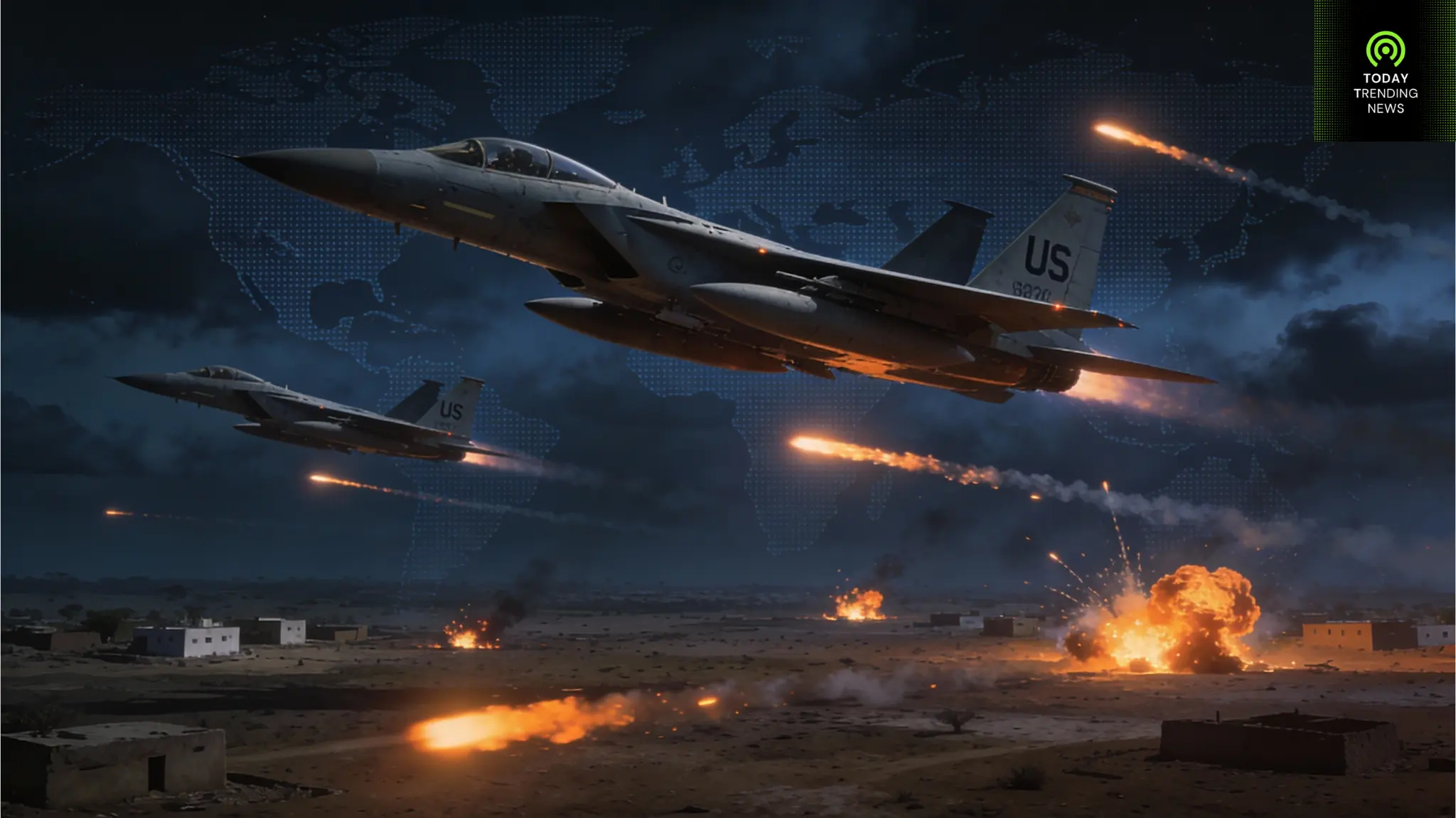
The US has used drastic and lethal airstrikes against ISIS fighters in northwestern Nigeria, in a military operation of spectacular proportions that is immediately making world news.
US President Donald Trump declared that the strikes were directed at fighters that were murdering people in the region mostly innocent Christians and that the strike was in direct reply to months of violent assaults.
What Exactly Happened In Northwest Nigeria?
The US Africa Command claimed that the airstrike targeted Islamic extremists, who are based in Sokoto State northwestern Nigeria and adjacent to Niger.
The operation was carried out, officials naturally state, at the bequest of the authorities of Nigeria, and the assassins killed several ISIS terrorists, but no official information has been put out concerning the number of them.
Officials of the Nigerian defence force asserted that it was an operation planned in tandem with the what they referred to as; credible intelligence and cautious logical planning to weaken the capacity of the group, whilst making efforts to ensure minimal civilian casualty.
The Nigerian Foreign Ministry also attached the strike to being a precision strike on the terrorist elements, highlighting how the entire conflict in the area is not only to Muslims, but also to Christians.
Why Did The US Strike Now?
The decision by Trump was not sudden as it was preceded by warnings and mounting pressure by religious organizations and political supporters in the US.
Trump has made numerous such assertions since the end of October, that Christians in Nigeria were at an existential threat and has stated publicly that there would be serious consequences should the killings go on.
On his post on Truth Social, Trump wrote that ISIS fighters in northwest Nigeria were targeting and brutally murdering, mainly innocent Christians, in a manner not witnessed in many years, and even centuries.
He included the fact that he had already warned these companies to cease or risk military action, stating that there were such on Christmas night.
This rhetoric meets his overall foreign-policy posture, in which he has frequently associated the US intervention to the defense of Christian communities just like the previous categorical words he made in regards to conflicts involving believers in the Middle East, and Africa.
Local Reality: Terror, Religion And Politics
Nigeria, Northwest and northern, has long been the target of ISIS-affiliated forces, ISWAP and other extremists, and also Boko Haram, and violent bandits.
Villages, security forces, religious sites and markets have been targets of these attacks in which both Muslim and Christian people have suffered in large numbers but when international stories are being told, they tend to concentrate on one particular side.
Nigerian authorities have rebelled against the notion that the violence revolves solely around the attack on Christians, arguing that the violence is multifaceted and multi-layered, and includes terrorism, banditry, local grievances and poor governance.
Nevertheless, the US portrayal of the strikes as a reaction to anti-Christian violence has found an immediate following amongst the evangelical communities, the Western media, and world Christian organisations which are likely to exert more political pressure to act.
For readers who track how global violence, politics and human cost connect across borders, earlier coverage like your Sydney terror attack explainer also shows how sudden assaults at public events can shake entire communities.
How Was The Operation Carried Out?
Although much of the details are still under secret, several reports indicate that there was a well planned air assault by the US-led team, assisted by intelligence by the Nigerian government and ground allies.
US Africa Command affirmed that aiming precision-guided munitions was employed in the Sokoto region in the strike, purporting that only militant targets were struck and that multiple ISIS terrorists had been neutralised.
According to the Defence Information department of Nigeria, the strikes were the result of several weeks of surveillance and collection of intelligence against a particular camp of ISIS affiliated elements, created to reduce the capabilities of unknown elements.
A US Defense Secretary, Pete Hegseth, made a public showing of appreciation to Nigeria, acknowledging the role of the country in supporting and cooperating and implied that there might be additions later in case the threat continues.
The operation is part of an overall US expansion of air operations in Africa, and earlier increases in operations in Somalia and the Sahel, as Washington attempts to deter ISIS and related forces developing safe havens.
Those theatres have also been subject to similar questions of casualties among civilians and long-term success, and so this strike in Nigeria is not the least part of a wider debate concerning how far the US power should extend in African conflicts.
For readers interested in how US decisions reshape economies and ordinary lives, your previous explainer on sanctions and oil shows another side of American power beyond airstrikes.
How Has Nigeria And The World Reacted?
The Nigerian government has officially embraced the move as a component of systemized collaboration with other international actors in the fight against violent extremism.
The Foreign Ministry emphasized that the country is determined to collaborate with the US and other countries on joint security activities, but at the same time the national sovereignty and autonomy of decision-making are focusing on the core level.
At the same time, the government of President Bola Ahmed Tinubu has responded to the stronger accusations made by Trump claiming that Nigeria does not safeguard Christians and that they are hyperbolic and unproductive.
According to some commentators in Nigeria, the danger of clustering the conflict too strictly in terms of religion is that it risks both increasing tensions and extremist propaganda on either side.
Human-rights organisations and analysts of conflicts already issue international warnings on the possibility of civilian casualties, as information on far-off locations usually trickles out and is hard to find out without other sources corroborating it.
European and African diplomats have been keen on whether this is to be only a one-off punitive strike or the onset of a protracted US military operation like in Iraq, Syria and Somalia.
For a wider conflict lens, readers can also revisit your coverage of the ongoing Ukraine war and its global implications in which explains how long wars shape diplomacy and security debates worldwide.
What Could Happen Next?
The allies of Trump have commended the airstrikes as a powerful message to the extremist groups that an offense against Christians will bring a direct response by the US.
However, critics claim that in the absence of a long-term political and development strategy in the north of Nigeria, single-day air operations would soon become the symbolic displays of power instead of the actual ones.
Security specialists caution that ISIS-affiliated units, ISWAP and violent bandits are likely to retaliate with revenge attacks particularly against soft targets such as villages, markets and places of worship.
Both Washington and Abuja will now be put at pressure to demonstrate that not only does this operation work to enhance the security problems on the ground but also that it does not necessarily be transferred to other parts.
To the international audience, the US airstrikes in Nigeria are a wakeup call that the subcontinent wars in Africa are still squarely on the global security agenda together with the Ukraine war and threats in the Indo-Pacific.
And as the world watches, debates over power, justice and security echo the questions raised in your analysis of rising global trends and uncertainties in.
As events unfold, Today Trending Newz will have further coverage on new utterances by the US, Nigerian government and other international observers and any confirmed information about Sokoto and the neighboring areas.